
The rapid global adoption of electric vehicles (EVs) is transforming the transportation industry and accelerating the transition toward cleaner, more sustainable mobility. Governments, automakers, energy providers, and urban planners are investing heavily in EV infrastructure to support the growing number of electric cars on the road. While many EV owners enjoy the convenience of charging at home using private driveways or garages, millions of urban residents face a major challenge: the lack of off-street parking.
This issue is especially significant in densely populated cities where apartments, condominiums, and terraced housing dominate residential areas. For these residents, installing a private home charging system is often impractical or impossible. On-street EV charging has emerged as a critical solution to bridge this infrastructure gap and enable broader EV adoption.
On-street EV charging refers to charging stations installed along public roads, curbsides, residential streets, parking bays, lamp posts, sidewalks, and other publicly accessible urban locations. These charging systems allow EV drivers to conveniently charge their vehicles near their homes or workplaces without requiring dedicated private parking spaces.
As electric mobility continues to expand worldwide, on-street charging is becoming one of the most important components of urban transportation infrastructure. Cities are increasingly integrating curbside charging networks into smart city planning, sustainability programs, and carbon reduction initiatives. The development of reliable, accessible, and affordable on-street charging networks is expected to play a major role in the future of urban transportation.
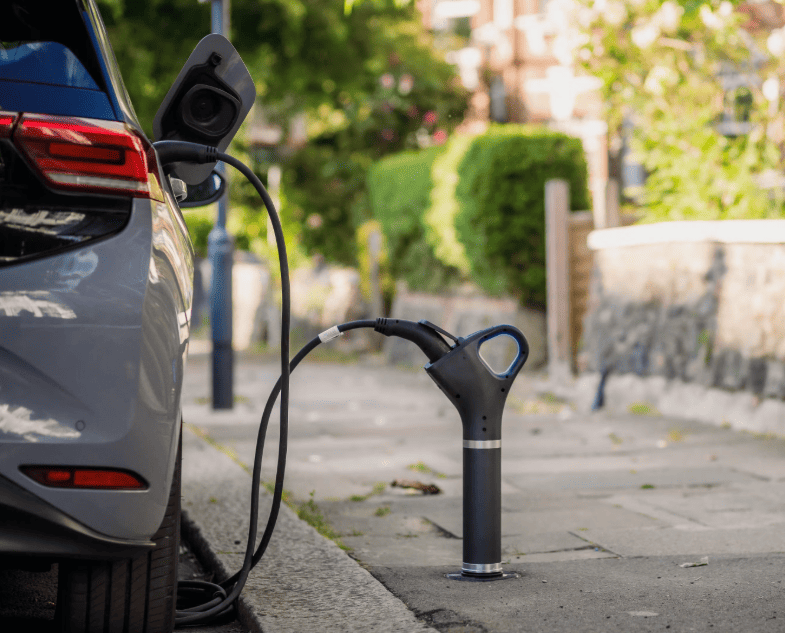
On-street EV charging is designed primarily for drivers who park their vehicles on public roads rather than in private garages or driveways. These charging solutions are typically installed directly into existing street infrastructure or mounted on dedicated charging pillars positioned near parking spaces.
Unlike large commercial fast-charging hubs commonly found along highways or shopping centers, on-street charging systems are usually intended for longer-duration charging sessions, especially overnight charging. This approach aligns with the parking behavior of residential users who leave their vehicles parked for several hours.
Most on-street chargers operate at slower AC EV charging speeds, commonly ranging from 3 kW to 7 kW. Although slower than DC fast chargers, these systems are generally sufficient for overnight residential charging and daily commuting needs.
For example:
- A 3 kW charger may fully recharge a small EV overnight.
- A 5 kW charger offers moderate charging speed suitable for most urban drivers.
- A 7 kW charger can typically add substantial driving range during an overnight session.
Depending on battery size, ambient temperature, and vehicle charging capability, most EVs can recharge to approximately 80% capacity within 6 to 12 hours using on-street charging stations.
This charging method provides convenience while reducing dependence on centralized public charging stations, which may involve longer travel distances, waiting times, or higher charging costs.
Urban areas are experiencing rapid EV adoption due to stricter emissions regulations, expanding low-emission zones, fuel cost concerns, and increasing environmental awareness. However, cities also contain large populations of residents without private parking access.
Without accessible residential charging infrastructure, many potential EV buyers hesitate to transition away from gasoline-powered vehicles. On-street charging directly addresses this issue by providing near-home charging opportunities.
In many metropolitan areas, apartment buildings lack dedicated EV charging systems. Retrofitting older buildings can be expensive and technically challenging due to electrical limitations, ownership structures, and parking constraints.
On-street charging offers an alternative that allows apartment residents to charge their vehicles nearby without requiring major building renovations.
A comprehensive charging ecosystem is essential for large-scale electrification. Public fast chargers alone cannot support all charging demands efficiently. Distributed residential charging networks reduce pressure on fast-charging infrastructure while improving charging accessibility for all drivers.
Cities worldwide are implementing aggressive carbon neutrality targets. Transportation emissions remain one of the largest contributors to urban air pollution and greenhouse gas emissions. Expanding on-street charging networks supports cleaner transportation systems and helps governments meet environmental objectives.
Charging bollards are standalone charging pillars installed along sidewalks or parking spaces. These are among the most common on-street charging systems.
- Advantages include:
- Easy accessibility
- Simple installation
- Flexible placement
- Clear user visibility
- Smart payment integration
Modern bollards often feature smart networking capabilities, RFID authentication, mobile app integration, and real-time monitoring systems.
Lamp post charging has become increasingly popular in urban environments. Existing street lighting poles are upgraded with integrated charging sockets, minimizing additional street clutter and reducing installation costs.
Benefits include:
- Efficient use of existing infrastructure
- Reduced installation complexity
- Lower civil engineering requirements
- Improved urban aesthetics
Lamp post chargers are particularly suitable for densely populated cities with limited sidewalk space.
Pop-up charging systems remain hidden underground when not in use and rise above ground during charging sessions. These innovative systems help preserve urban aesthetics and reduce sidewalk obstruction.
Advantages include:
- Minimal visual impact
- Enhanced pedestrian safety
- Space optimization
- Reduced vandalism risk
Although installation costs can be higher, pop-up chargers are increasingly used in historic city centers and premium urban districts.
Kerbside charging systems are embedded directly into curbs or sidewalks adjacent to parking spaces. Drivers can connect charging cables without bulky charging pillars occupying pedestrian areas.
These systems are gaining popularity in compact urban environments where sidewalk space is limited.
Wireless inductive charging technology is emerging as a future solution for on-street EV charging. Vehicles charge automatically through electromagnetic induction pads installed beneath the road surface.
Potential advantages include:
- Fully automated charging
- Improved convenience
- Reduced cable management issues
- Enhanced accessibility for disabled users
Although still in early deployment stages, wireless charging may become a key component of future smart cities.
On-street charging systems generally follow a straightforward process:
The EV driver parks in a designated charging bay.
The driver connects the charging cable to the vehicle.
Authentication is completed through:
- RFID card
- Mobile application
- QR code
- Contactless payment
Charging begins automatically.
The charging session is monitored through cloud-based software platforms.
Payment is processed after charging completion.
Many modern systems also support:
- Remote charger management
- Energy consumption tracking
- Smart scheduling
- Dynamic load balancing
- Real-time fault detection
- Renewable energy integration
These smart capabilities improve network efficiency and user convenience.
Many cities are installing publicly accessible charging networks throughout residential neighborhoods, transportation hubs, and commercial districts.
Municipal authorities often prioritize locations such as:
- Residential streets
- Public parking areas
- Libraries
- Government buildings
- Transit stations
- Schools
- Community centers
These installations support residents who lack private charging access while promoting EV adoption.
Private businesses may apply for permits to install on-street charging systems near their facilities. Retail centers, hotels, restaurants, office buildings, and supermarkets increasingly offer curbside charging to attract EV-driving customers.
Businesses benefit through:
- Increased customer traffic
- Sustainability branding
- Additional revenue opportunities
- Enhanced customer convenience
Some municipalities allow homeowners without driveways to apply for residential curbside charging permits. Approved residents can install charging points directly outside their homes while complying with local infrastructure and safety regulations.
This approach provides equitable charging access for urban residents living in older neighborhoods.
On-street charging expands charging access to millions of urban residents who otherwise may not be able to own EVs conveniently.
Accessible neighborhood charging reduces concerns about battery depletion and charging availability.
A reliable charging infrastructure encourages more consumers to switch from internal combustion engine vehicles to electric vehicles.
Curbside charging maximizes utilization of existing parking infrastructure without requiring large dedicated charging facilities.
On-street charging integrates well with broader smart city initiatives involving renewable energy, intelligent transportation systems, and digital infrastructure.
Widespread EV adoption contributes to:
- Lower greenhouse gas emissions
- Reduced urban air pollution
- Improved public health
- Lower noise pollution
Limited Urban Space
Dense urban areas often have narrow sidewalks and congested streets, making charger installation difficult.
Grid Capacity Constraints
Large-scale EV charging deployment places additional pressure on local electrical grids. Upgrading grid infrastructure may be necessary in some neighborhoods.
Installation Costs
Civil engineering work, electrical upgrades, permitting, and maintenance can result in significant deployment costs.
Cable Management and Safety
Charging cables stretched across sidewalks may create trip hazards for pedestrians if not properly managed.
Vandalism and Weather Exposure
Public charging systems must withstand:
- Harsh weather
- Physical damage
- Vandalism
- Vehicle collisions
Durable equipment design is essential for long-term reliability.
Charger Availability and Parking Enforcement
Unauthorized parking in charging bays can limit charger accessibility. Effective enforcement policies are needed to ensure availability for EV users.
Governments worldwide are introducing policies and incentives to accelerate on-street charging deployment.
Many regions offer:
- Infrastructure grants
- Installation subsidies
- Tax incentives
- Public-private partnership funding
These programs help reduce deployment costs for municipalities and businesses.
Cities increasingly incorporate EV charging into urban development regulations, building codes, and transportation planning strategies.
Some governments now require new developments and parking facilities to include EV charging readiness.
National and regional carbon reduction goals continue driving investment in charging infrastructure expansion.
Modern on-street charging systems increasingly rely on advanced digital technologies.
Smart Charging
Smart charging systems optimize energy consumption by adjusting charging rates based on:
- Grid demand
- Electricity pricing
- Renewable energy availability
- User preferences
Load Balancing
Dynamic load balancing prevents electrical overload by distributing available power efficiently across multiple chargers.
Mobile Applications
Mobile apps allow users to:
- Locate available chargers
- Reserve charging spaces
- Monitor charging progress
- Process payments
- Receive notifications
Data Analytics
Charging operators use analytics to improve:
- Infrastructure planning
- Maintenance scheduling
- Usage optimization
- Energy efficiency
On-street charging networks are increasingly integrated with renewable energy systems.
Some municipalities deploy solar canopies or renewable energy connections to support sustainable charging operations.
Battery storage systems help stabilize grid demand by storing electricity during low-demand periods and supplying energy during peak charging times.
Future on-street charging networks may support bidirectional charging, enabling EVs to return electricity to the grid during periods of high demand.
This technology could improve grid resilience and support renewable energy integration.
Europe
European cities are among the global leaders in on-street charging deployment. Countries such as the Netherlands, Norway, Germany, France, and the United Kingdom have invested heavily in residential curbside charging programs.
Dense urban populations and strong environmental policies continue driving infrastructure expansion.
North America
The United States and Canada are rapidly increasing investments in public EV charging infrastructure. Many cities are piloting lamp post charging, curbside charging, and residential permit programs.
Asia-Pacific
China, Japan, and South Korea are aggressively expanding EV infrastructure as part of broader electrification initiatives. Large-scale smart city projects are accelerating deployment.
Emerging Markets
Developing countries are gradually exploring on-street charging solutions as EV adoption begins to increase in urban areas.
Ultra-Compact Charger Designs
Future charging systems will become smaller, more visually integrated, and easier to deploy within crowded urban environments.
Autonomous Charging
Robotic charging systems may eventually automate cable connection and charging processes.
AI-Driven Energy Management
Artificial intelligence will optimize charging schedules, predict energy demand, and improve grid efficiency.
Wireless Dynamic Charging
Some future roadways may enable EVs to charge while driving through embedded wireless charging systems.
Integration with Autonomous Vehicles
Self-driving EVs may autonomously locate available on-street chargers and recharge without human intervention.
Expanded Interoperability
Standardized payment systems and charging protocols will improve compatibility across networks and simplify the user experience.
The expansion of on-street charging infrastructure creates significant economic opportunities across multiple industries.
Governments and private companies are investing billions of dollars into charging network expansion, generating demand for:
- Electrical equipment manufacturers
- Construction companies
- Software developers
- Utility providers
- Engineering firms
The EV charging industry supports employment in:
- Manufacturing
- Installation
- Maintenance
- Software development
- Energy management
- Urban planning
Charging accessibility increasingly influences property attractiveness and urban development strategies.
EV charging networks are reshaping electricity demand patterns and accelerating the modernization of power grids.
Manufacturers play a critical role in advancing on-street charging technology through continuous innovation in:
- Charger efficiency
- Durability
- Connectivity
- User interface design
- Smart energy management
- Safety systems
Key industry priorities include:
- Reducing installation costs
- Improving charger reliability
- Enhancing cybersecurity
- Supporting renewable integration
- Simplifying maintenance
Technology providers are also developing advanced cloud-based management platforms that enable scalable deployment and efficient network operation.
On-street EV charging has become an essential component of the global transition toward sustainable transportation. As electric vehicle adoption continues accelerating, accessible residential charging infrastructure is critical for supporting urban drivers who lack private parking facilities.
By enabling convenient near-home charging, on-street charging networks help eliminate one of the biggest barriers to EV ownership in densely populated cities. From lamp post chargers and kerbside systems to smart charging platforms and future wireless technologies, the industry is evolving rapidly to meet growing demand.
Despite challenges involving infrastructure costs, grid capacity, urban space limitations, and regulatory complexity, governments, municipalities, businesses, and technology providers are working together to expand charging accessibility worldwide.
The future of urban mobility will depend heavily on reliable, intelligent, and sustainable charging infrastructure. On-street EV charging represents not only a practical solution for modern cities but also a major step toward cleaner transportation, reduced emissions, and smarter urban living.
As EV technology advances and charging networks continue expanding, on-street charging will play an increasingly important role in supporting the widespread adoption of electric vehicles and shaping the sustainable cities of tomorrow.
