
As electric vehicles (EVs) continue to expand across global markets, charging infrastructure has become a critical component of sustainable transportation systems. One of the most important elements in this ecosystem is the EV charger socket, which directly determines compatibility, charging speed, and user experience.
Different regions and manufacturers adopt various charging socket standards to support alternating current (AC) and direct current (DC) charging systems. These standards influence everything from home charging convenience to high-speed public charging networks. Understanding EV charger socket types is essential for manufacturers, infrastructure developers, fleet operators, and EV users.
Today's EV charging landscape is primarily divided into AC slow/fast charging systems and DC rapid charging systems. Each category uses different connector types and socket configurations depending on power requirements and regional standards.
This article provides a comprehensive overview of EV charger socket types, including Type 1 and Type 2 AC connectors, DC rapid charging systems, and the key factors that influence global standardization and deployment.

Alternating current (AC) charging is the most common method used for home, workplace, and destination charging applications. In AC EV charging systems, electricity is supplied to the vehicle in AC form and converted into DC by the vehicle's onboard charger.
AC charging is generally divided into:
- Slow charging (Level 1)
- Fast charging (Level 2)
These systems typically use standardized EV charger sockets that ensure compatibility across different vehicle brands and charging stations.
The Type 2 connector is the most widely used AC charging standard in Europe and is increasingly adopted in many other global markets. It is the primary socket type used for home charging, workplace charging, and public destination charging stations.
Type 2 sockets are designed as universal AC charging interfaces, meaning most EV drivers must use their own charging cable to connect their vehicle to the charging point.
Type 2 charging supports a wide range of power levels:
7kW (Single-phase AC charging)
Provides approximately 25 miles (40 km) of range per hour
22kW (Three-phase AC charging)
Provides up to 75 miles (120 km) of range per hour
The higher the power rating, the faster the charging speed, making 22kW systems especially suitable for commercial and workplace environments.
- Universal compatibility across most EV brands in Europe
- Supports both single-phase and three-phase charging
- Designed for untethered charging stations
- Common in public charging infrastructure
- Requires users to carry their own charging cable
Because of its flexibility and scalability, the Type 2 standard has become a cornerstone of modern EV charging networks.
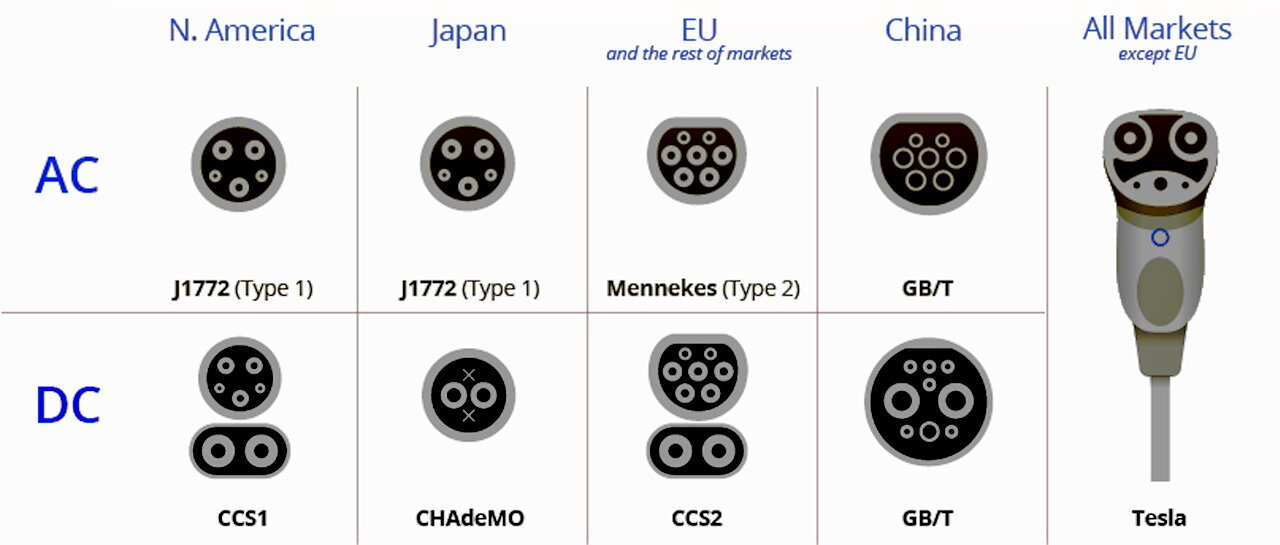
The Type 1 connector is an older AC charging standard that is still found in some regions and legacy charging systems. It is primarily used in North America and Japan for earlier-generation EV models.
Type 1 chargers are often found in older public charging installations or early workplace charging systems. However, they are gradually being phased out in favor of more universal standards.
- Typically single-phase AC charging
- Lower charging power compared to Type 2 systems
- Often uses tethered cables (attached to charging stations)
- Limited compatibility with modern EV models
As EV technology evolves, most new charging infrastructure avoids Type 1 connectors in favor of more flexible and globally compatible systems. Many public charging points now prioritize Type 2 or multi-standard connectors to ensure broader vehicle compatibility.
AC charging stations can be categorized into two main design types:
- No fixed cable attached to the charger
- Users must bring their own charging cable
- Common in Type 2 installations
- Offers flexibility for different vehicle types
- Built-in charging cable attached to the unit
- Easier for users (no need to carry cable)
- Often used in residential or older public installations
- Typically associated with Type 1 or legacy systems
Modern infrastructure trends strongly favor untethered Type 2 systems due to their adaptability and long-term scalability.
Unlike AC systems, DC fast chargers deliver direct current directly to the vehicle battery, bypassing the onboard charger. This enables significantly faster charging speeds.
In most DC charging systems, there is no traditional socket on the charging unit. Instead, cables are permanently attached (tethered) to the charger due to their size, weight, and high power handling requirements.
DC charging cables are significantly larger than AC cables because they must handle much higher current levels. For safety, durability, and operational efficiency, these cables are integrated into the charging station.
- Higher power delivery capability
- Improved safety and thermal management
- Reduced user handling complexity
- Faster charging sessions
- Simplified station design
Most rapid charging stations provide one, two, or even three tethered cables depending on site design and power distribution requirements.
DC fast charging systems typically use standardized connectors depending on region and manufacturer:
- CCS (Combined Charging System)
- CHAdeMO (used mainly in Japan)
- GB/T (China standard)
- Tesla proprietary connectors (in certain regions)
Many modern charging stations now support multi-standard compatibility to accommodate different EV models.
The selection and adoption of EV charger socket types depend on several important technical and regulatory factors.
One of the most fundamental distinctions in EV charging is between AC and DC power delivery.
- AC charging relies on the vehicle's onboard converter
- DC charging delivers direct power to the battery
Socket design must match the electrical architecture of the charging system, influencing both connector shape and power handling capacity.
Different regions adopt different EV charging standards based on regulatory frameworks and market development.
Europe: Type 2 (AC), CCS2 (DC)
- North America: Type 1 / J1772 (AC), CCS1 (DC), Tesla NACS increasingly adopted
- Asia (China): GB/T standard for both AC and DC systems
- Japan: CHAdeMO and Type 1 legacy systems
These regional differences require manufacturers and infrastructure developers to ensure compatibility across markets.
EV charger socket types are closely linked to charging performance levels:
- Level 1 (Slow AC Charging): Basic residential charging
- Level 2 (Fast AC Charging): Home, workplace, and public charging
- DC Fast Charging: High-speed commercial and highway charging
Higher charging speeds require more robust connectors and advanced thermal management systems.
EV manufacturers play a major role in shaping charging socket adoption.
For example:
- Tesla uses its own connector in some markets but is expanding compatibility
- European manufacturers predominantly use Type 2 and CCS standards
- Asian manufacturers follow GB/T or CHAdeMO depending on region
As EV markets globalize, cross-compatibility is becoming increasingly important.
EV charging socket technology has evolved significantly over the past decade. Early systems were fragmented, with multiple incompatible standards across regions and manufacturers.
Today, the industry is moving toward:
- Unified charging standards
- Multi-protocol charging stations
- Smart communication between vehicle and charger
- Higher power delivery efficiency
This evolution supports faster EV adoption and simplifies infrastructure development.
Modern EV charger sockets are not only electrical connectors but also data communication interfaces.
They support:
- Vehicle authentication
- Charging session monitoring
- Energy management systems
- Remote diagnostics
- Billing and payment integration
Smart communication protocols such as OCPP (Open Charge Point Protocol) enable seamless integration between charging stations and cloud-based management platforms.
Safety is a critical factor in EV charging infrastructure. Modern socket systems include:
- Overcurrent protection
- Thermal monitoring
- Ground fault detection
- Waterproof and dustproof designs (IP-rated enclosures)
- Automatic shutdown mechanisms
These features ensure safe operation in both residential and public environments.
The EV charging industry continues to evolve rapidly, and socket technology is expected to advance in several key areas.
Standardization and Global Compatibility
Efforts are ongoing to reduce fragmentation and improve global interoperability of charging connectors.
Higher Power Charging Systems
Future DC charging systems will support ultra-high power levels, requiring advanced connector materials and cooling technologies.
Wireless Charging Integration
Inductive charging systems may reduce reliance on physical sockets in certain applications.
Smarter Charging Ecosystems
AI-driven energy management and smart grid integration will enhance charging efficiency and reduce infrastructure strain.
EV charger socket technology plays a foundational role in the development of global electric vehicle infrastructure. From widely used Type 2 AC connectors to high-power DC rapid charging systems, each socket type serves a specific purpose within the broader charging ecosystem.
As EV adoption continues to grow worldwide, standardization, interoperability, and technological innovation will remain key drivers shaping the future of charging infrastructure. Whether in residential, commercial, or high-speed public charging applications, EV charger socket systems will continue to evolve to meet increasing demands for efficiency, convenience, and sustainability.