
As electric vehicles (EVs) continue to surge in popularity across the globe, residential charging technology has become a central focus for drivers and industry innovators alike. Among the most compelling recent developments is dual-outlet home AC EV charging — a solution that empowers homeowners to conveniently charge two EVs simultaneously using alternating current (AC) power from a single charging station. With growing EV adoption, increasing living space constraints, and demand for smarter energy usage, dual-outlet home AC chargers are rapidly emerging as a key enabler of the electric mobility transition.
This in-depth report explores the rise of dual-outlet home AC charging, its technical landscape, market drivers, user benefits, installation considerations, challenges, policy support, and its long-term potential in reshaping how EV owners power up at home.
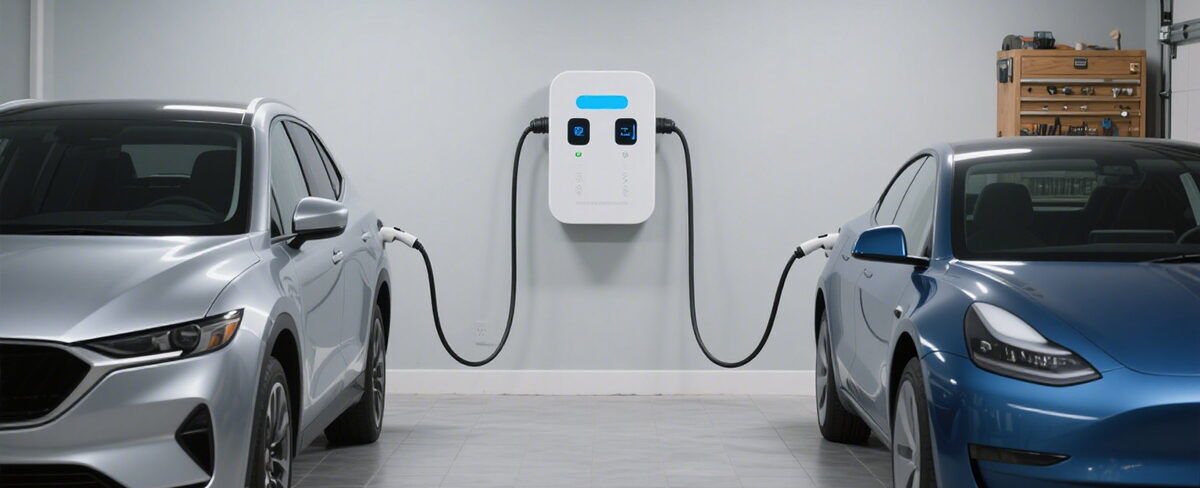
Residential EV charging has evolved significantly since the era of simple Level 1 chargers that connected to standard household outlets. Today's electric vehicles often come with larger battery capacities, meaning longer charging times and higher power demands. While DC fast charging stations deliver rapid top-ups on the go, home charging remains critical to everyday use — particularly for overnight replenishment.
Dual-outlet home AC chargers represent an innovation in this space by enabling two EVs to draw AC power simultaneously from a single device, typically installed in a garage, carport, or driveway.
Unlike mainstream single-outlet chargers that can serve only one vehicle at a time, dual-outlet units support:
- Concurrent charging — two vehicles charging together without waiting.
- Load balancing — intelligent distribution of available input power between outlets.
- Flexible scheduling — prioritization of vehicles based on user preferences.
The rise of such solutions is not just about convenience; it reflects shifting household dynamics. With EV adoption spreading to families with multiple drivers, vehicle sharing scenarios, and mixed-use properties (e.g., rental units with separate EV drivers), the ability to charge two cars at once is becoming a practical necessity.
According to a broad array of market research estimates, the percentage of U.S. households owning more than one EV has climbed steadily in recent years — propelled by expanding EV model availability and declining battery costs. Once niche, EV ownership now spans families, urban dwellers, and fleet drivers transitioning to electric.
The result? Households increasingly face the logistical puzzle of when and how to charge multiple EVs without excessive reliance on public infrastructure.
For most EV owners, home charging accounts for a large share of total energy top-ups. Studies and user surveys repeatedly show that the convenience, cost-efficiency, and reliability of at-home charging far outweigh the occasional use of public stations for everyday needs.
Dual outlets amplify that convenience. With two ports ready to serve two vehicles, homeowners can avoid rotation, scheduling conflicts, or extended idling at shared public stations.
As public charging networks expand, capacity constraints still challenge high-use corridors and urban centers. By enabling more EV charging at the residential level — including multiple vehicles per home — dual-outlet units can relieve pressure on public fast chargers during peak hours.
This redistribution of load toward off-peak home charging aligns with broader grid management strategies that utilities and policymakers are promoting.
Today's dual-outlet AC chargers often integrate smart load-balancing algorithms. Rather than forcing both outlets to draw maximum power at all times, these devices dynamically allocate available current based on:
- Total household load
- Time-of-use rate structures
- Utility demand charges
- Scheduled charging windows
This means homeowners can optimize energy costs by scheduling charging during off-peak hours — at 10 p.m., for example — and let the charger automatically adjust power distribution between the two vehicles.
Dual-outlet home AC EV chargers are typically categorized as Level 2 charging equipment, operating on 240 V AC service — the same type used by large appliances such as electric dryers or ovens.
- Two Charging Ports: Each socket can deliver AC power to its connected vehicle.
- Smart Load Sharing: The most critical functionality. If both vehicles are charging, the charger intelligently divides available current (e.g., 80 A total split into 40 A each, or customized distributions per user settings).
- Communication Protocols: Support for standards like OCPP (Open Charge Point Protocol), Wi-Fi/4G connectivity, and compatibility with EV apps for tracking and control.
- Safety Mechanisms: Ground-fault protection, temperature monitoring, and overcurrent safeguards.
- User Interfaces: LCD displays, mobile apps, or integrated dashboards for scheduling and status updates.
In a typical installation, a dual-outlet AC charger is hardwired to the home's electrical panel via a dedicated 240 V circuit — often 60 A or higher, depending on local codes, available service, and intended charging power.
Load balancing is the heart of these chargers’ utility. As most U.S. homes have fixed electrical service capacity (e.g., 100 A or 200 A main breaker), it's inefficient and potentially problematic to allow two EVs to draw high power simultaneously without regard to other household loads.
Smart chargers solve this by:
- Monitoring total current draw from both outlets
- Measuring overall household consumption
- Dynamically adjusting output so total draw stays within safe limits
For example, if a home has only 60 A allocated for EV charging and both vehicles plug in, the charger might split 30 A to each port, or provide 40 A to one and 20 A to the other, depending on battery state, user priorities, and schedule settings.
Installing a dual-outlet home charger shares many similarities with single-outlet solutions, but there are unique considerations homeowners should keep in mind.
A qualified electrician must evaluate the home's main panel to ensure sufficient capacity. Common scenarios include:
- 200 A service with room for a 60 A EV circuit
- 100 A service nearing capacity, requiring electrical panel upgrades
- Homes with solar plus energy storage systems, which introduce additional integration decisions
Panel upgrades can be costly but worthwhile, especially for households that plan to electrify more systems beyond EVs (e.g., heating, appliances).
Dual-outlet chargers are typically installed where two vehicles park side by side — most often in garages or driveways.
Factors that installers consider include:
- Cable lengths for convenient reach to both vehicles
- Weatherproofing for outdoor units (commonly NEMA 3R or IP54 ratings)
- Line-of-sight and mounting height for easy plug-in/out
- Integration with home automation platforms
Many municipalities have electrical permitting requirements for EV charger installations. Dual-outlet units may be subject to:
- Local building and electrical codes
- Utility notifications or inspections
- Incentive program regulations
Proper permitting ensures safety and eligibility for rebates or tax credits.
The advantages of installing a dual-outlet home AC EV charger go beyond merely saving trips to a public station.
For a household with two EVs — whether spouses, roommates, or shared family vehicles — having simultaneous charging means no juggling schedules or switching charging spots.
This translates to:
- Less time managing charging logistics
- More predictable departure readiness each morning
- No reliance on sometimes unreliable public network availability
Smart dual-outlet chargers that offer scheduling and load management open doors to energy cost savings:
- Charging during off-peak hours when electricity rates dip
- Avoiding demand charges (for owners on certain rate plans)
- Taking advantage of solar generation windows if paired with home solar
This leads to potentially significant reductions in total charging cost compared to unscheduled, high-power draws.
Real estate professionals increasingly recognize EV charging readiness as a desirable home feature. Just as garages with electric vehicle readiness can attract buyers, dual-outlet charging solutions may provide additional appeal — especially for multi-EV households.
While the benefits are compelling, there are several challenges and adoption barriers that homeowners and the broader industry must navigate.
High-quality dual-outlet chargers are more expensive than single-outlet units. Typical cost factors include:
- Hardware price premium for two ports and smart controllers
- Electrical panel upgrades or larger service capacity
- Professional installation expenses
Although incentives and rebates can offset some costs, the initial investment remains a consideration for many buyers.
Jobs that involve panel upgrades, trenching for outdoor units, or integrating home energy systems may extend installation timelines and require coordination with licensed professionals.
Not all EV owners are familiar with smart charging features, scheduled load balancing, or utility rate optimization. Ensuring manufacturers and installers provide adequate user education is key to maximizing value.
One of the most exciting intersections in residential electrification is the integration of EV charging with solar generation and home energy storage.
Many dual-outlet AC chargers are designed to work alongside rooftop solar systems. When paired with energy storage (like home batteries), homeowners can:
- Charge vehicles preferentially using solar during the day
- Use stored energy to supplement charging at night during peak hours
- Reduce net grid demand and electricity bills
With utilities increasingly offering time-of-use rates, integration gives homeowners competitive leverage in managing energy costs.
While most current residential EV chargers focus on intake power, bi-directional charging — where power can flow from vehicle to home or grid — is gaining traction.
Dual-outlet chargers that support such modes could, in the future, allow:
- EV batteries to power the home during outages
- Participation in grid programs for demand response
- Additional revenue streams through utility incentives
Although bi-directional consumer deployments are still emerging, dual-outlet infrastructure could be well-positioned to support the technology as it matures.
Government policy and utility incentive programs have played a significant role in accelerating residential EV charging uptake.
In the United States, several federal tax credits and incentive programs support home EV charger purchases and installations. These can include:
- Investment tax credits (ITC) for EV charging infrastructure
- State rebates for Level 2 charger hardware
- Utility-sponsored rebates and demand-management credits
In many cases, incentives apply to qualifying dual-outlet units as long as they meet relevant efficiency and safety standards.
Forward-thinking utilities offer TOU rate plans that align well with smart charger scheduling. For example:
- Lower rates overnight (e.g., 10 p.m. – 6 a.m.)
- Mid-day solar export periods with favorable pricing
- Demand charges for high midday home loads
Dual-outlet chargers with load balancing allow homeowners to maximize these programs by spreading demand intelligently.
To understand the real-world impact of dual-outlet home charging, we spoke with both EV owners and energy industry insiders.
“We have two EVs and a daily rhythm that used to involve constant charger switching,” said one California homeowner who installed a dual-outlet unit last year. “Now both cars charge overnight, and we never worry about which one goes first. The smart load balancing means we don’t overload the rest of the house either.”
Another EV owner from the Midwest described significant savings after enrolling in a utility TOU program and scheduling his dual chargers accordingly: “Our charging costs dropped nearly 25 % once we optimized based on off-peak rates.”
Experts in residential energy management emphasize the strategic value of dual outlets in the broader electrification ecosystem.
“Dual-outlet home EV charging is one of those technologies that may seem incremental but has large systemic benefits,” noted an energy consultant. “It enables flexibility, reduces peak grid stress, and supports smarter energy use — especially when integrated with solar and storage.”
Manufacturers also highlight how future firmware updates could introduce even more advanced features, such as AI-driven charging optimization based on weather, grid conditions, and historical usage.
The road ahead for residential EV charging is poised for rapid evolution. Dual-outlet AC charging may soon be followed by innovations such as:
Where chargers not only deliver power to vehicles but draw it back during peak pricing events or outages.
Integrating EV charging, solar, storage, battery health management, and home energy dashboards into a seamless platform.
Smart algorithms that learn household behaviors and automatically adjust charging for maximum efficiency and cost savings.
Dual-outlet and even higher-port solutions in condos, apartments, and residential communities, backed by networked access control and billing.
As electric vehicles become central to how people move, home charging infrastructure must keep pace with evolving needs. Dual-outlet home AC EV chargers offer a compelling blend of convenience, cost-efficiency, and grid-aligned smart operation for families and multi-vehicle households.
With supportive policy environments, rising EV penetration, and growing integration with broader home energy systems, dual-outlet charging is not just a convenient accessory — it is a cornerstone of the residential electrification landscape.
For EV owners, it means more freedom, better energy management, and peace of mind. For utilities and climate goals, it represents distributed, intelligent load shaping that can make grid operations more resilient and efficient.
As one industry leader noted, “The future of home charging isn’t just about more power — it's about smarter, shared, and sustainable power.”
